Browse practical recipes without barriers
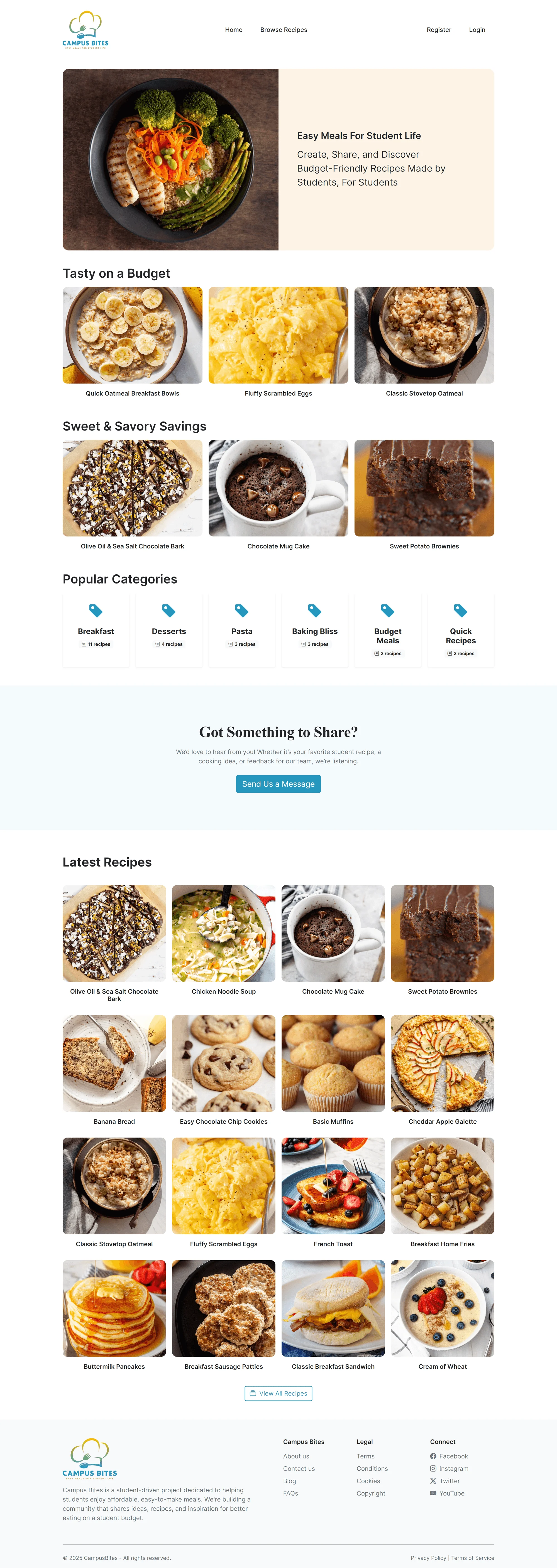
Visitors need a clean, searchable database of budget-friendly meals with zero account setup. They should never see half-baked drafts or unapproved ingredients.
Student recipe and moderation platform
Registered students can contribute recipes, images, and novel ingredients. The challenge lies in maintaining library integrity while keeping contribution open, resolved through draft-first publishing, quarantined media assets, and a role-aware review queue.
The Problem
The primary challenge extends beyond recipe discovery. The system must support a collaborative catalog where student submissions, proposed ingredients, and image uploads are securely partitioned and reviewed before public release.
The Users
The platform manages permission boundaries cleanly so that visitors get instant, trustworthy search results while contributors and administrators collaborate through secure state changes.
Visitors need a clean, searchable database of budget-friendly meals with zero account setup. They should never see half-baked drafts or unapproved ingredients.
Registered students can write recipes, suggest new ingredients, and upload raw photos. Their draft is saved immediately, but unapproved parts are quarantined from the public.
Administrators manage the publishing gate. They verify novel ingredients and check uploaded images before moving the recipe into the public index.
The first decision
The interface treats moderation as part of the recipe journey, not an admin-only afterthought.
This would make contribution feel instant, but it risks unverified images, noisy ingredients, and public recipes that admins have not approved.
Unverified content stays private until an admin clears it, so the public library never shows anything that has not been reviewed.
A contributor saves a meal draft, entering instructions and tagging ingredients.
DraftImages and novel proposed ingredients are isolated from public search.
Hidden from PublicAn administrator inspects the image contents and ingredient tags.
Admin GateApproved assets migrate to public folders, and the recipe joins the library students search and browse.
PublicFailed files are deleted; comments go back to the author for revision.
Back to DraftModeration states
Images and newly proposed ingredients are reviewed before they ever reach the public library, and the interface shows that state plainly instead of hiding it.
| State | Contributor Experience | Public Library View | Admin Actions |
|---|---|---|---|
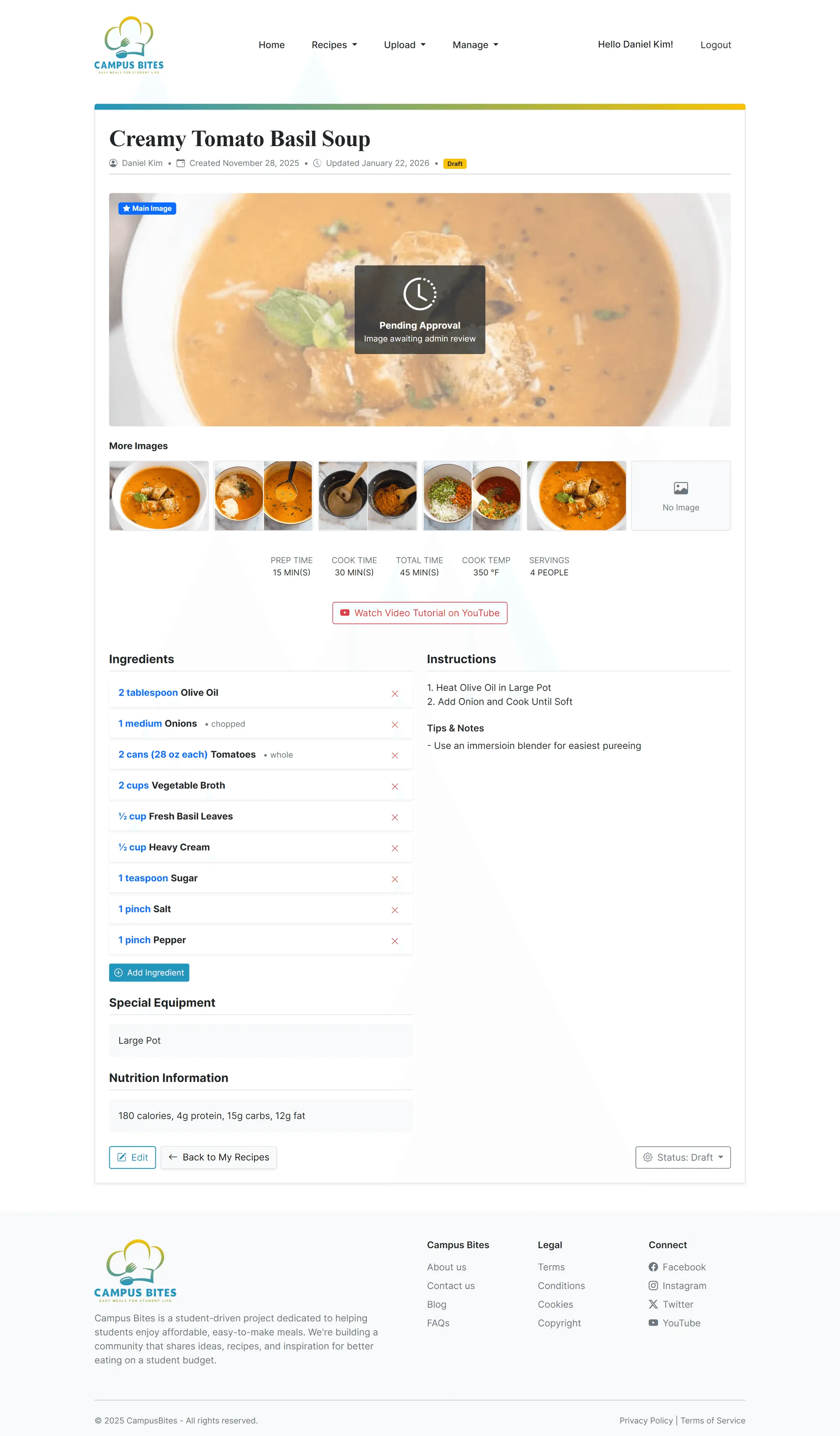
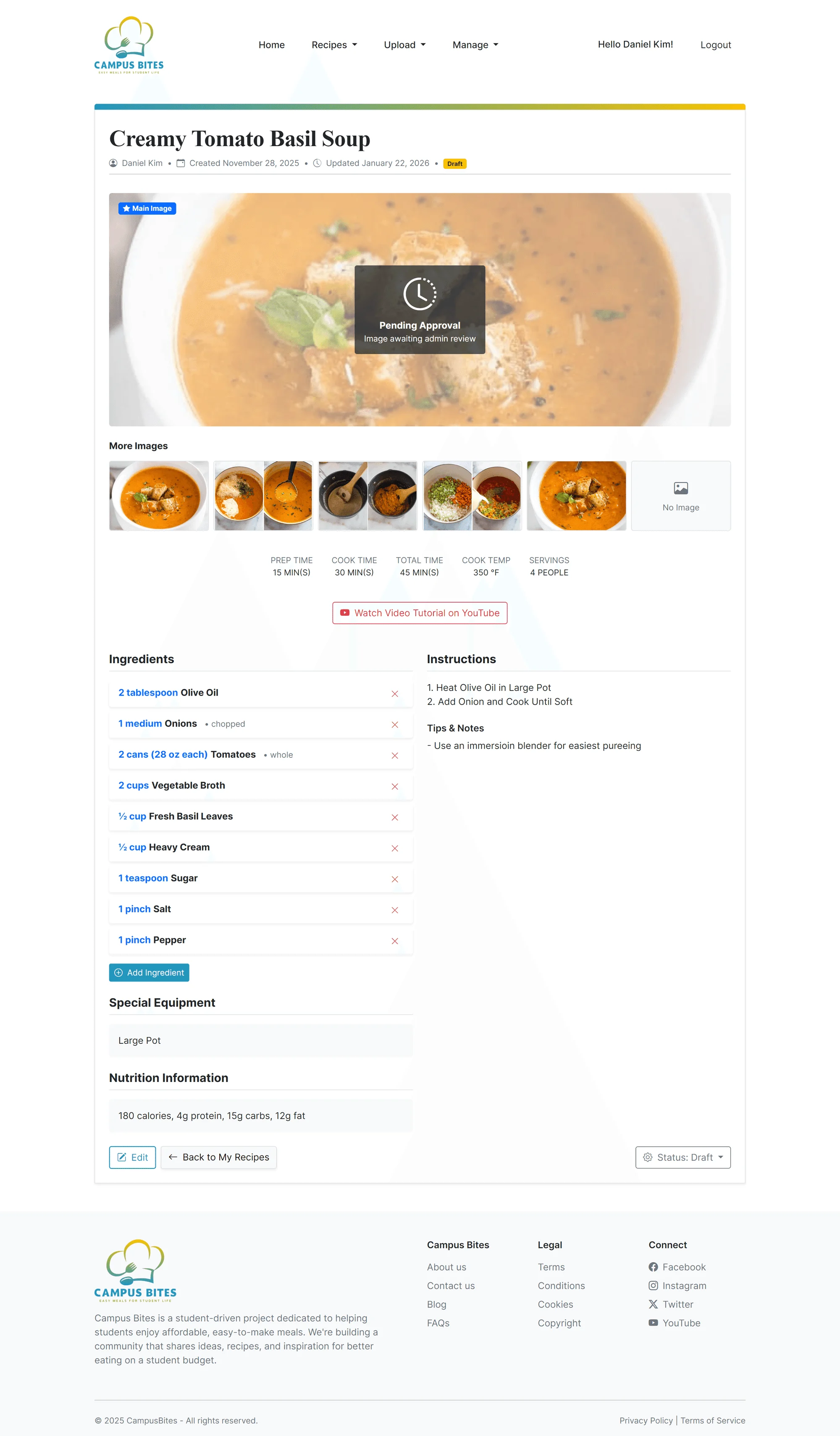
| Pending | Sees draft status indicator and a preview of their uploaded media marked "Awaiting Review". | Shows a generic "Image Not Available" placeholder; novel ingredients carry a warning label. | Can approve the asset, set as recipe main image, or reject with a specific reason. |
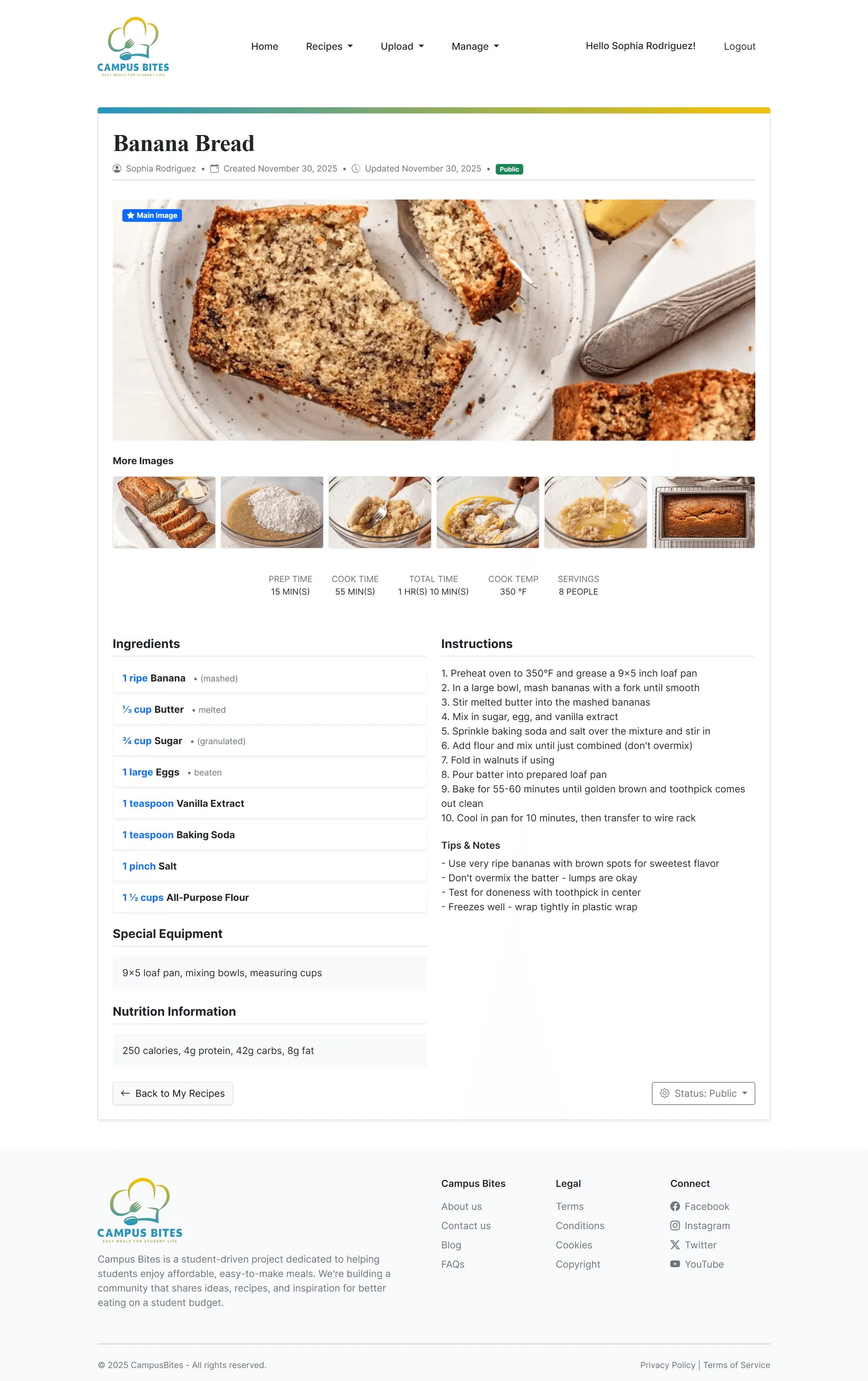
| Approved | Sees their recipe marked public; unapproved warning badges disappear from ingredient items. | Renders the real uploaded recipe image and verified ingredients in public search and lists. | Can revert the recipe back to draft or manage active main images if issues arise. |
| Rejected | Receives a dashboard notification containing feedback from the moderator on why files failed. | Recipe images and rejected ingredients are deleted from the disk and never expose public paths. | Provide written moderation reasons (e.g. poor image quality) that log to the contributor. |
Try It
Every recipe on Campus Bites carries a moderation state, and every surface obeys it: the image, the ingredient list, the visibility note, even the buttons an admin sees. This sandbox runs those exact rules on a single draft.
The Product
Each interface surface coordinates with the moderation engine to protect recipe library integrity without adding friction to student workflows.
01 · Moderation & Trust Surface
Pending recipes and unapproved assets stay private or are replaced with clear placeholders. The system protects public trust without making the contributor experience feel broken or mysterious.
02 · Discovery Surface
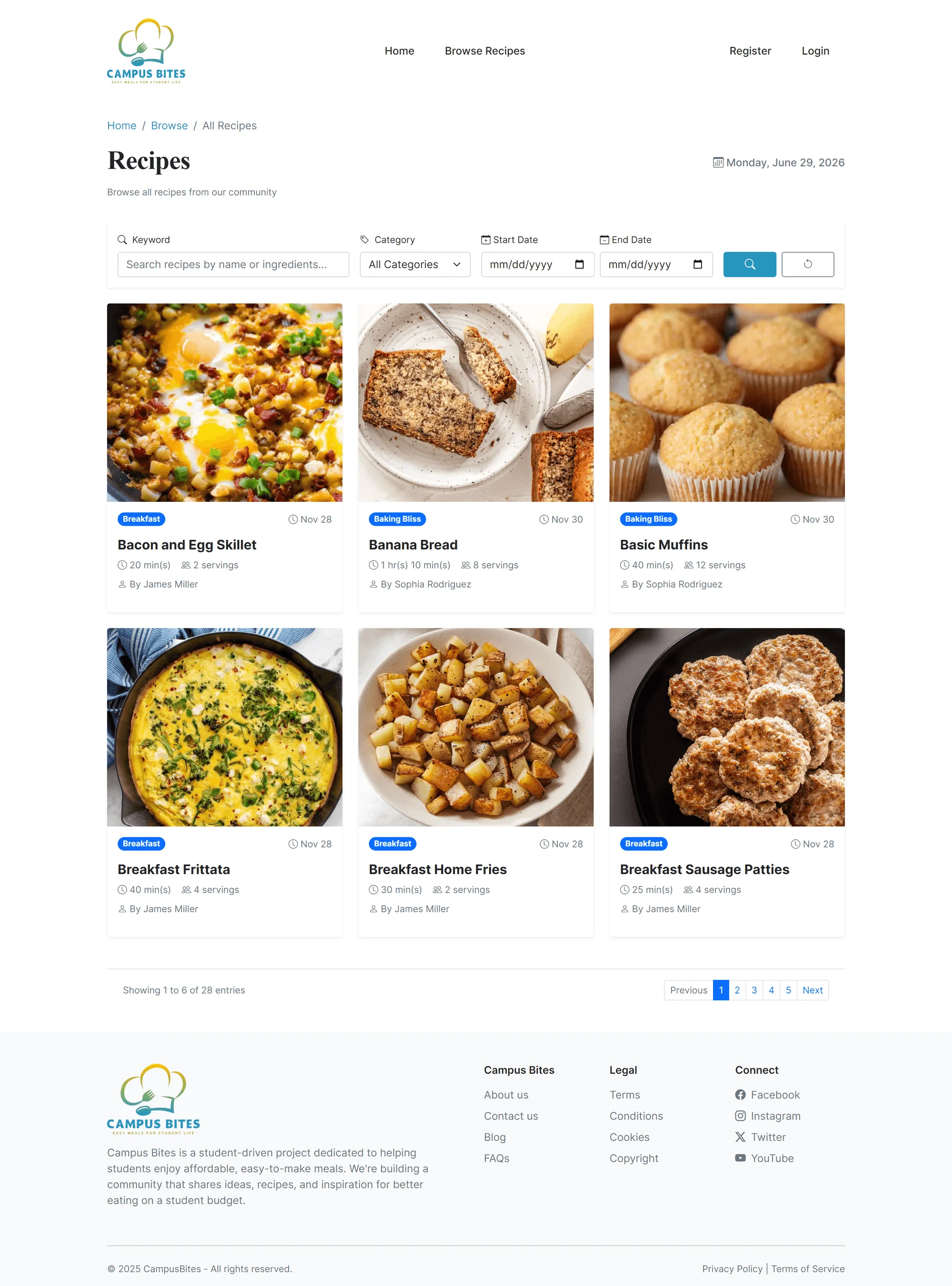
The public library supports combined keyword, category, and date range filtering. Pagination keeps load speeds fast while users scan budget constraints.
03 · Content Surface
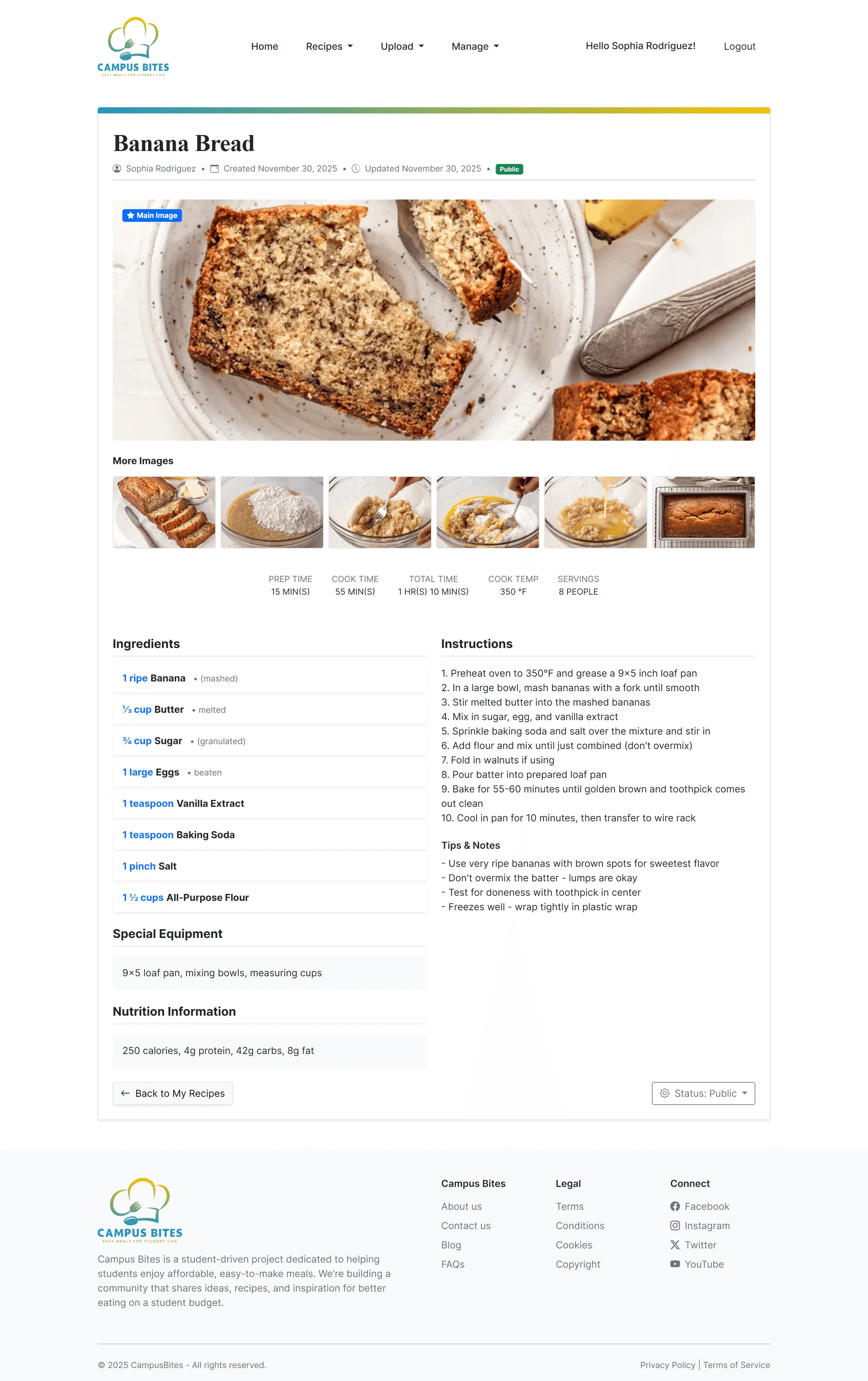
Recipes expose servings, preparation times, required appliances, and nutritional info. Students compare details on cards without opening every record.
The Stack
Architecture
ASP.NET Core MVC handles the user-facing workflows, Identity separates access levels, Entity Framework Core persists recipes and moderation state, and SQL Server keeps the content library queryable.
Anonymous Visitors, Registered Student Contributors, and Administrators submit intent to the server.
Controllers route the traffic; views render matching Razor templates depending on authorization state.
Middleware checks role boundaries, directing content modifications or moderation queues dynamically.
State models map to SQL Server tables, writing file paths and approval states securely.
Refinement
The core hypothesis is that exposing draft status, placeholders, and proposed-ingredient warning tags directly in the interface reduces confusion. Testing this state model with student contributors would validate its effectiveness in minimizing submission errors.
While the admin review queue is operational, it lacks key metrics like queue cycle times, common rejection categorizations, and contributor error patterns. Integrating these operational insights would streamline the review loop.
Physically moving uploads between local temp and public directories works for a prototype, but ties media storage to the application server disk. Scaling for production requires migrating media operations to cloud object storage paired with a global CDN.